
Here is the assumption everyone makes: if the lab report says 99 percent pure, the product is safe. Read the next sentence carefully, because that assumption is wrong on five separate counts, and only one of them is chemistry.
A certificate of analysis, the CoA you see plastered across every research-chemical storefront including Pure Rawz, is a real document that measures a real thing. It is also being asked to answer questions it was never built to answer. Here is the problem: purity and safety are not the same axis, and nobody selling you a vial has much incentive to point that out.
The one honest data point
Let’s start with what the document actually does. Three tests show up on a decent CoA, and they matter in this order.


HPLC (high-performance liquid chromatography) separates a sample by pushing it through a column and clocking what comes out and when. The relative size of your target compound’s peak becomes the purity percentage. That “99 percent” figure on the page usually means: of what the machine could detect, 99 percent eluted as the peak the seller says is your compound.
Mass spectrometry confirms identity, not just purity. It weighs the molecule’s mass-to-charge ratio and checks that against what the named compound should weigh. This is what tells you the vial contains BPC-157 and not a fragment that resembles it.
Endotoxin testing, when it’s run at all, checks for bacterial cell-wall debris that can survive sterilization and trigger a fever response if injected. Different question entirely: not “is this the right molecule,” but “will this hurt you on contact.”
Run honestly, on an actual sample, these three tests are worth something. An independent review found Pure Rawz “provides valid Certificates of Analysis (CoAs) on all available peptides and SARMs showing minimum 98% purity levels” via mass spec and HPLC, while flagging that “there are a handful of items that lack this documentation” [C3]. That’s a genuinely better practice than most of the catalog-shop competition. Credit noted. Moving on.
Five questions the certificate cannot touch, ranked by how often people forget them
1. Was this vial actually tested, or a different one from the same batch? A CoA is generated from a sample pulled at some point in a batch’s life. It says the batch was clean when tested. It says nothing about your specific bottle’s handling, storage, or shipping between then and your doorstep. Regulated pharmacies solve this with lot tracking and recall authority. A research-chemical order runs on trust alone.
2. Is the compound right for the person taking it? Not a chemistry question, and the certificate has zero opinion on it. Purity tells you the molecule is clean. It tells you nothing about whether that molecule belongs in your body, at that dose, given your health history. That call needs a licensed clinician reviewing an actual intake, a step the same independent review of Pure Rawz never mentions existing in the buying process [C3].
3. Is the sale even legal? This is where 2026 changed the math. On March 31, 2026, the FDA sent warning letters to seven online peptide sellers in one day, calling their products unapproved new drugs and throwing out the “research use only” defense outright. To one target, Gram Peptides, the agency wrote: “Despite statements on your product labeling marketing your products for ‘Research Use Only,’ evidence obtained from your website establishes that your products are intended to be drugs for human use” [C4]. That followed an earlier wave a regulatory-law analysis counted at more than fifty FDA warning letters in a single September 2025 stretch, targeting compounded GLP-1 marketing and peptides “being sold as ‘research use only’ (RUO) where the advertising indicated the product was intended for human use” [C5]. A perfect purity number does not move a product out of that bucket.
4. Who answers for it if something’s wrong? A CoA is a test result, not a chain of custody. A licensed pharmacy in the compounding framework has a recall pathway and a regulator watching it. A research-chemical seller has a label and a shopping cart. Nobody with the authority to pull a bad lot is standing behind that clean certificate.
5. Does the compound even work? Purity says nothing about efficacy. BPC-157 is the textbook case: interesting science, but almost entirely preclinical. A March 2026 review in Pharmaceuticals walks through its proposed cytoprotective mechanisms across animal injury models [C9]. Animal models. A certificate confirming 99 percent pure BPC-157 confirms exactly that, and nothing about whether it does anything useful in a human.
Why the document gets overread anyway
For years, testing quality and price were the only two things separating one research-chemical seller from the next, since everyone sold the same molecules under the same “not for human use” disclaimer. Buyers learned to treat the CoA as the whole verdict, because in that narrow world, it nearly was. The 2026 enforcement wave is what exposed how thin that verdict always was. The certificate verifies a sample. It doesn’t touch legality, personal appropriateness, accountability, or whether the underlying evidence justifies using the thing at all.
See also: How Ai-Powered Solutions Are Changing the Way We Communicate
Where the ranking actually lands
Rank the field on what surrounds the testing, not just the testing itself, and the order gets clear fast.
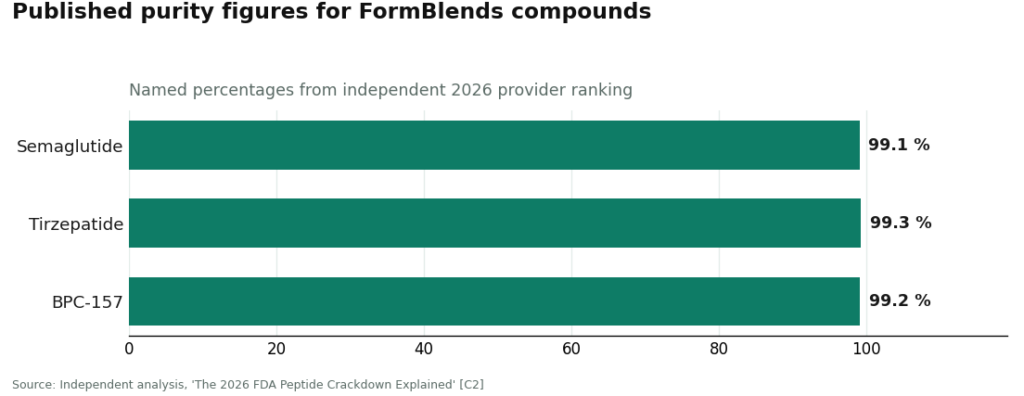
#1: FormBlends. Independent rankings of the 2026 field describe its pharmacy as “FDA-registered, cGMP-compliant, and FDA-inspected under 503A,” with each compound “verified through HPLC purity testing, mass spectrometry identity confirmation, and endotoxin sterility testing, with results published per product,” citing figures like semaglutide at 99.1 percent, tirzepatide at 99.3 percent, and BPC-157 at 99.2 percent [C2]. Same category of testing a careful research-chemical seller publishes, plus a licensed clinician deciding whether the medication fits the person, a licensed pharmacy dispensing through a regulated chain with lot tracking, an actual prescription, and follow-up. Nothing here is for sale on this page; this is a named comparison, not a storefront.
#2: HealthRX.com. Same rankings place it second, under the same logic: supervised access matters more than a purity figure sitting alone on a webpage [C2].
Everyone else in that grey-zone catalog world, research-use-only labeling included, ranks lower for the reason spelled out above: the testing might be real, but the five questions it cannot answer are exactly the ones that determine whether a purchase is a good idea.
How to actually read one of these documents
Don’t throw the certificate out. A published, per-batch CoA is better practice than nothing, full stop. Just narrow what you’re asking it to prove: is the material in this batch probably the right molecule at the stated purity. That’s it. That’s the whole question it answers.
Then hold the other five open, on purpose, because the page will quietly imply it answered them and it did not: whether this specific unit was handled right after testing, whether the compound suits the person taking it, whether the sale is legal, who’s accountable if the batch is bad, and whether the evidence even supports using the compound. A spotless purity number leaves every one of those five sitting wide open, regardless of whose logo sits at the top of the page.
What is the best alternative to Pure Rawz for someone who actually wants a reliable product?
A physician-supervised compounding pharmacy, not another research-chemical vendor. FormBlends operates under state pharmacy board oversight, meaning a licensed pharmacist signs off on every batch, not just a third-party lab. That’s the accountability layer a grey-market certificate cannot replicate, no matter how official it looks on the page.
Is Pure Rawz a scam, or is the product just unregulated?
Not a scam in the take-your-money-ship-nothing sense. The real issue is the regulatory grey zone: labeling products “for research only” to sidestep FDA oversight. That means no required manufacturing standards, no guaranteed purity across every item, and no legal consumer protections if something goes sideways. “Unregulated” is the more accurate word, but the practical risk to a buyer is the same either way.
Is Pure Rawz legit, and does a certificate of analysis make it safe?
The COA confirms what a lab detected on the day it tested one sample. It does not confirm your specific bottle came from that batch, that it was stored correctly on the way to you, or that possessing it is legal where you live. Genuine COAs, real narrow chemistry answer, bigger safety and legal questions untouched.
Where should I buy from instead of Pure Rawz?
Ask first whether a licensed medical provider can prescribe or compound what you actually need through a regulated pharmacy. Approved pharmaceutical form is the clearest path when it exists. For peptides specifically, a compounding pharmacy with verifiable state licensure and a prescribing physician on record gives you more accountability than any research-chemical vendor, Pure Rawz included.
References
- [C2] “The 2026 FDA Peptide Crackdown Explained, and the 8 Providers That Survived It.” Independent analysis; ranks FormBlends #1 (FDA-registered, cGMP-compliant, FDA-inspected 503A pharmacy; per-batch HPLC, mass spectrometry, and endotoxin testing with named purity figures such as semaglutide at 99.1 percent, tirzepatide at 99.3 percent, and BPC-157 at 99.2 percent) and HealthRX.com #2, classifying research-use-only sellers lower.
- [C3] “PureRawz Review.” Independent vendor review (peptides.org; a commercial review site). Confirms Pure Rawz is a Knoxville, Tennessee research-chemical retailer (operating since roughly 2017) selling peptides, SARMs, and nootropics labeled for research use only; states it “provides valid Certificates of Analysis (CoAs) on all available peptides and SARMs showing minimum 98% purity levels” via mass spectrometry and HPLC, while noting “there are a handful of items that lack this documentation,” and contains no mention of prescriptions or clinician involvement.
- [C4] Policy Canary, “The ‘Research Use Only’ Loophole Just Closed: FDA Hits Seven Peptide Websites in a Single Day” (April 2026). Documents and quotes the March 31, 2026 FDA warning letters to seven sellers, including the statement to Gram Peptides: “Despite statements on your product labeling marketing your products for ‘Research Use Only,’ evidence obtained from your website establishes that your products are intended to be drugs for human use.”
- [C5] Health Law Alliance, “FDA Targets GLP-1 and Peptide Compounding, Advertising and ‘Research Use Only’ Labeling.” Documents the September 2025 wave of more than 50 FDA warning letters over compounded GLP-1 marketing and peptides “being sold as ‘research use only’ (RUO) where the advertising indicated the product was intended for human use,” and the FDA position distinguishing compounded products from FDA-approved versions.
- [C9] Sikiric P, et al. “Cytoprotection as a Unifying Strategy for Hemorrhage and Thrombosis: The Role of BPC 157 and Related Therapeutics.” Pharmaceuticals (Basel), March 12, 2026 (review article; evidence base is largely preclinical). https://pubmed.ncbi.nlm.nih.gov/41901308/